Activities of NENCPPH

Current Activities
Previous Activities
Heart Disease and Stroke Prevention


The CDC-funded NC HDSP Program focuses on systems-level change to create health promotion and cardiovascular disease prevention. Because of the complexity and prevalence of cardiovascular diseases and risk factors, no single program working alone can make a difference.
The NC HDSP Program seeks to work with multiple partner organizations – both public and private – in settings across the state to address chain of survival issues and secondary prevention with a focus on the ABCS (Aspirin Therapy, Blood Pressure and Cholesterol Control, Smoking Cessation, and reduced Sodium intake); while supporting collaboration with other NC Chronic Disease and Injury Section Branch-funded efforts in addressing physical activity, unhealthy eating, tobacco use, diabetes, and overweight/obesity, as well as emergency response and acute health care systems for heart attack and stroke.
The NC HDSP Program has identified African Americans as a priority population because health surveillance data show that this group bears a disproportionate burden in terms of heart disease and stroke death rates and risk factors in NC. Visit Start with Your Heart for more information about the NC Heart Disease and Stroke Prevention Program.
Four regions in NC are supported by HDSP Regional Coordinators, including Northeastern and Eastern NC. The Northeast NC HDSP Program Regional Coordinator works closely with the Eastern Regional Coordinator of the Program to manage the Eastern NC Stroke Network (ENCSN). Anyone who is a stroke champion can become a member. There are approximately 500 members of the ENCSN representing 30 eastern NC counties.
The vision of ENCSN is to be recognized as a leading resource for voluntary collaboration on stroke best practices in eastern NC communities. The mission of ENCSN is to improve the prevention, treatment, and quality of stroke care in eastern NC through a coordinated regional system. Visit ENCSN for more information about the Eastern NC Stroke Network.
Disease Surveillance
Improvements to disease surveillance in the region are being reviewed by the NENCPPH. A regional disease surveillance discussion was held with Communicable Disease Nurses, Preparedness Coordinators, Health Educators and a Health Director from the partnering local health departments, an Epidemiologist from Vidant Medical Center, and the facilitator from the North Carolina Institute of Public Health. NCDETECT also provided input during the meeting. The group reviewed which indicators should be used to monitor disease surveillance, as well as the frequency of reporting, the format for reporting, and to whom the reports should be sent.
After further review and discussion by the NENCPPH Board, an improved reporting and surveillance system shall be put into use in the region. Possibilities for expanded implementation exist.
Public Health Awareness
NENCPPH has gathered member local health department representatives together, along with a representative from the North Carolina Institute for Public Health, to work collaboratively to develop a coordinated regional plan for increasing public awareness of core public health functions. Current public health awareness initiatives were reviewed. Possible strategies were prioritized to reach the identified target populations. Possible strategies are being drafted for consideration by the NENCPPH Board. Local Universities have been contacted to assist in developing some of the strategies.
Quality Improvement: LEAN and QI 101

The health departments comprising the Northeastern Partnership are committed to continuous quality improvement. One means to achieve quality improvement is to apply models from successful businesses.
In conjunction with consultants, the Northeastern Partnership has reviewed business model assets such as Lean and Six Sigma which can be applied toward solving high priority public health problems and organizational challenges. These models map current business practices and develop teams that can look at tailoring new business practices in ways that address local public health department issues, such as billing practices, clinic efficiency, and client satisfaction with services at the local health department.
Lean trainings, as well as two on-site kaizen events, have been provided to each health department in the Partnership using the Lean model. During the kaizen events, staff and facilitators work together on-site to analyze and improve upon practices and procedures. Health departments have reported great improvements to their clinic efficiencies, and a positive return on their investment thanks to the Lean trainings and kaizen events.
Currently, three of the health departments in the Northeastern Partnership are partnering with the North Carolina Center for Quality Improvement to look at other areas of improvement using their QI 101 course, which also utilizes concepts from Lean.
Other General Activities
- Networking with Healthy Carolinians task forces and other community coalitions and organizations to share ideas, identify community problems and resources and address public health problems
- Providing regional training sessions to local health professionals
- Seeking funding to implement regional programs to address regional health concerns
- Documenting the NENCPPH's History in a written summary
- Developing ways to address common internal needs of the partnering health departments
Eliminating Health Disparities
We recently completed a Community Focused Eliminating Health Disparities Initiative from the State Office of Minority Health and Health Disparities which was focused on increasing awareness of health disparities and developing solutions with local Disparity Gap Coordinators.
Each health department had allocated a health educator from their staff to serve as a Disparity Gap Coordinator. These Coordinators help to link the Partnership to community coalitions such as Healthy Carolinians and school health advisory councils, and help to implement programs conducted by the NENCPPH. In addition, the Disparity Gap Coordinators attended quarterly trainings on how to implement culturally appropriate public health programs. For examples on activities which occurred in the various counties, take a look at the newsletter, “Giving Clarity to Disparities.”
A Regional Health Disparities Coordinator was spearheading the development of a large collaborative, the Eastern Health Network, that would create collaborations between faith based organizations, community based organizations, health departments, schools, and government. The aim of the project was to create avenues to strengthen communities via capacity and infra-structure building and sharing resources across county lines to eliminate health disparities in the eastern region of North Carolina. Other activities conducted by the Regional Health Disparities Coordinator included conducting focus groups, holding meetings and trainings, assisting the Disparity Gap Coordinators to review and revise their county action plans, working with church youth groups regarding diabetes/kidney disease, and planning a leadership conference. Due to changes in funding at the State-level, the position of Regional Health Disparities Coordinator was discontinued.
The 4th Annual Health Disparities Leadership Conference, “Bringing Communities Together, Connecting the Pieces” was held on June 24, 2011 at the Bob Martin Center in Williamston. Approximately 100 participants shared and learned about ways we can come together for the betterment of our communities.
Epidemiologic Capacity of Local Health Departments
An epidemiologist was hired by the Partnership to analyze and present county and regional health data for 11 local health departments in the Partnership at the time. In addition, the epidemiologist has provided region-wide training for health department staff. Trainings have included Principles of Epidemiology, Epi Info software, and Presenting Health Data. The Epidemiologist has responded to health department requests for data and other technical assistance.
Touch No Tobacco
TNT was a tobacco prevention program aimed at teens in 11 of the counties served by NENCPPH. The purpose of the program was to prevent tobacco use initiation, eliminate exposure to secondhand smoke, promote tobacco cessation, and reduce health disparities attributable to tobacco use. A Project Coordinator, four Youth Tobacco Prevention Coordinators and a Media/Marketing Specialist formed the staff of the program which was funded by the Health and Wellness Trust Fund. The project developed a list of tobacco-free restaurants in Northeastern North Carolina.
Diabetes Sentinel Program
Through this project, the Northeastern Partnership increased its capacity to prevent, diagnose and medically manage diabetes among African Americans, and sought to reduce health disparities in the 19-county region.
The Diabetes Sentinel program was a collaboration of 30 African American churches and public health providers for diabetes prevention, outreach and policy change. Each participating congregation identified adult and youth leaders for training as lay advisors (Sentinels), created a committee to support this effort, established and implemented policies that promote healthy lifestyles, and sponsored workshops on diabetes, nutrition, and exercise.
College Tobacco Prevention
This Tobacco-Free Colleges Initiative served 18-24 year olds attending college in Beaufort, Chowan, Dare, Edgecombe, Halifax, Hertford, Martin, Pamlico and Pasquotank counties. Funding for the project was provided by a NC Health & Wellness Trust Fund grant (2006). Statewide efforts to address tobacco use and exposure to secondhand smoke (SHS) have been primarily focused on youth ages 12-17 and adults. However, studies at the time showed that 18-24 year olds represented the only group in which smoking rates were rising rather than falling.
College students are especially vulnerable to tobacco addiction. Nationally, 29% of college students were current smokers. In North Carolina, 27.8% of 18-24 year olds smoked and of those, 58% had tried to quit in the last year. Colleges and universities across North Carolina were challenged with helping the three-quarters majority to remain non-smokers, and encourage current smokers to quit.
The Northeastern Regional grant provided services and support to the following institutions:
- Beaufort Community College*
- Chowan University
- College of the Albemarle**
- Edgecombe Community College
- Halifax Community College
- Martin Community College
- Pamlico Community College
- Roanoke-Chowan Community College**
*Indicates smoking not allowed within 50 ft away from buildings
**Indicates total smoke/tobacco-free policy
Project goals included:
- Preventing the initiation of tobacco use
- Reducing exposure to environmental smoke
- Providing information on treatment options for those wishing to quit through cessation techniques including Quitline NC
- Reduce health disparities attributable to tobacco use
- Advance the adoption of Tobacco-Free Campus policies
Health in Motion: a Mobile Outreach Clinic
NENCPPH launched the mobile clinic project, Health in Motion, in northeastern North Carolina. The goal of the NENCPPH mobile clinic was to provide at risk populations access to Human immune virus (HIV) prevention and primary care and treatment services. The mobile clinic also visited communities to provide screenings for cholesterol, diabetes, hypertension, and infectious diseases. Health in Motion received funding from a Ryan White Title II grant and a Kate B. Reynolds grant.
The Northeastern Partnership's Regional HIV Program expanded the partners' capacity:
- To deliver Primary Medical HIV care at five regional mobile care sites (Bertie, Beaufort, Dare, and Halifax Counties in the NENCPPH region, and also to Lenoir County)
- To provide nontraditional HIV/STD testing services targeting communities considered at risk (573 individuals were tested for HIV in 2007)
- To raise awareness of HIV and provide HIV prevention education (40 outreach activities occurred in 2007).
The partnership received additional funding through grants to promote and sustain this initiative through increased staffing of a regional coordinated care team, funding two regional nontraditional testing coordinators, and funding a jail HIV/STD testing coordinator.
Common Billing Initiative
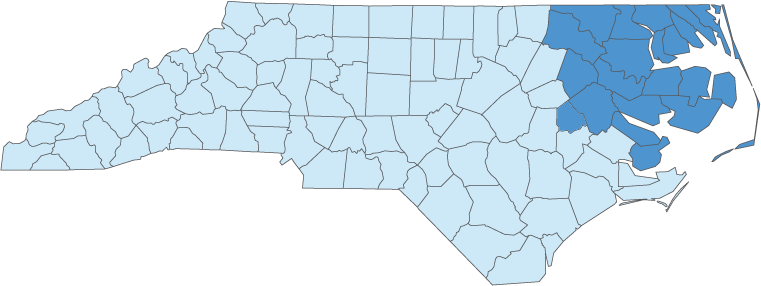
Built on a consultant’s assessment of the billing practices of the region’s 11 local health departments (covering 19 counties) the NENCPPH created a work group which established a compendium of best practice policies and procedures to address billing and coding issues, provide benchmarks for performance and alerts for further action. This process has helped maximize reimbursements and resulted in the creation of a best practice manual used as a resource tool and training vehicle across the region.
North Carolina Public Health Incubator Initiative
In 2004, the NC legislature authorized the creation of "public health incubators," innovative organizations that foster more effective and efficient allocations of resources. The incubators enable a "critical mass" of resources and shared activities that are often necessary to provide essential public health services and are otherwise unavailable to many of the under-resourced local health districts that are Incubator participants. The Public Health Incubators are modeled after the Northeastern North Carolina Partnership for Public Health (NENCPPH) which was formed in 1999 and has demonstrated the efficacy of such a partnership. The NENCCPH is one of six public health “incubators” previously funded through this initiative. The following project was being implemented by the NENCPPH with 2007/2009 Incubator Funds: NENCPPH Infrastructure Support and Business Insights/Lean: Applying Lean QI concepts to Public Health.

Regional Health Assessments
Completed an updated regional health assessment using secondary data in 2012. In 2003-2005, the NENCPPH conducted and published a regional health assessment and focused studies of diabetes, HIV/AIDS and heart disease/stroke in the region. All include statistical health data and community opinions and concerns. Reports are distributed to residents, health and social service agencies, legislators, the state public health division and community organizations in the region.
Obesity and Diabetes Health Information Campaign
Conducted a health information campaign to reduce obesity and diabetes in the region.
Informing the North Carolina General Assembly
In the past, the NENCPPH has worked with the North Carolina General Assembly to educate them about the need to provide funding to health departments for the delivery of core public health functions. Unlike some states, local health departments in North Carolina do not receive funding to carry out this important local health department role.